3PL Packing Verification: How Top 3PLs Prove Quality to Their Clients
A brand client calls on a Tuesday morning. They received three complaints overnight from customers who got the wrong product. They want to know what happened, and they want to see proof. You pull up your WMS logs. The orders show as “shipped.” The scan-verify records show green across the board. But you can’t actually show the client what was in each box. You can tell them your system says it was right. You can’t prove it.
This is the gap that separates 3PLs who retain clients from 3PLs who lose them.
The multi-client complexity problem
Running a single brand’s fulfillment is straightforward enough. One set of SOPs, one packaging standard, one quality bar. Running eight brands from the same facility is a different operation entirely.
Each brand client has their own requirements:
- Packaging materials. Brand A wants custom tissue paper and a sticker seal. Brand B wants plain kraft paper. Brand C wants a specific poly mailer with their logo.
- Insert requirements. Some clients need promotional cards, return labels, or samples in every order. Others only want inserts for first-time customers.
- Box presentation. The brand selling $200 candles expects a different unboxing experience than the brand selling $15 phone accessories. Some brands care how items are arranged. Others don’t.
- Quality thresholds. One client tolerates a 1% error rate. Another has a 0.5% SLA with financial penalties. A luxury brand considers any error unacceptable.
When your packers switch between clients throughout the day, cross-contamination risk goes up. Brand A’s insert ends up in Brand B’s order. Brand C’s custom tissue gets skipped during a rush. The wrong poly mailer gets grabbed because they’re stored next to each other.
This multi-client complexity is the defining operational challenge for 3PLs, and it’s exactly where packing verification matters most.
What brand clients actually want
Brand clients evaluating 3PLs, or reviewing existing partnerships, increasingly ask for three things:
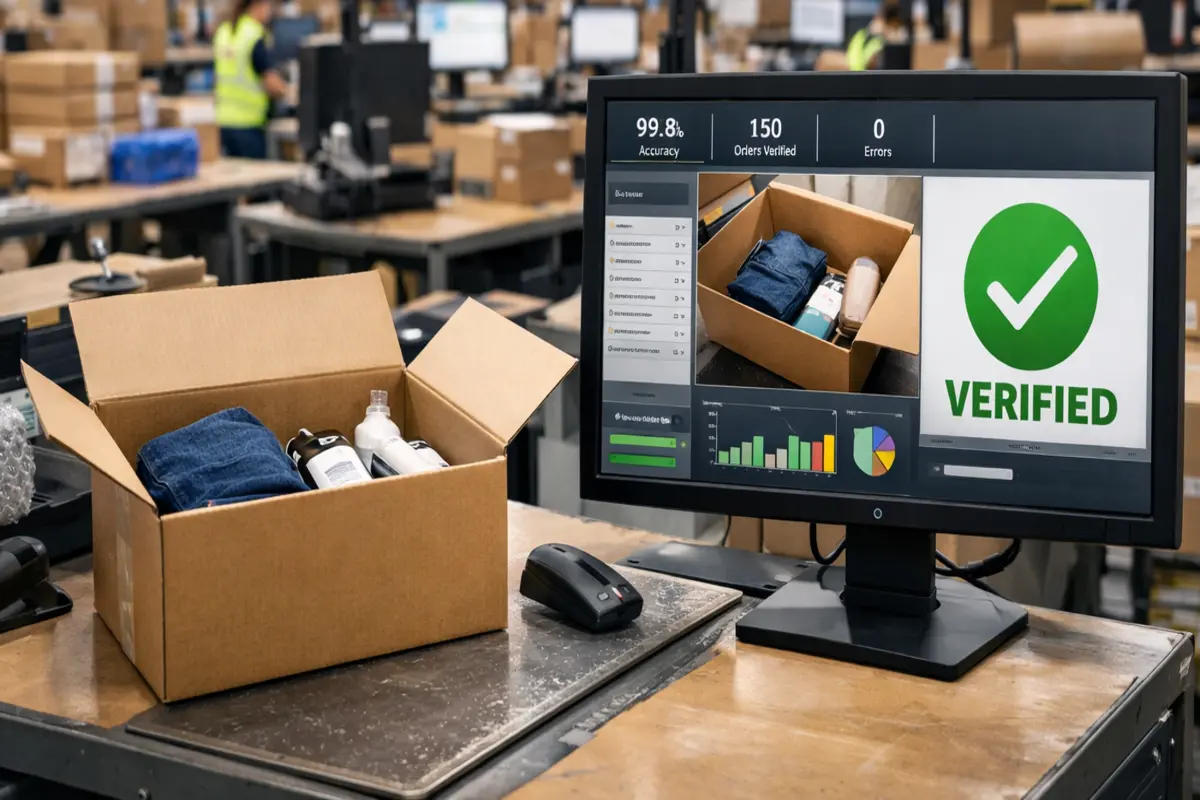
1. Proof that their orders are packed correctly. Not a report that says “99.2% accuracy.” Visual proof: photos or video showing what was in the box for any order they want to check. When an ops team can pull up the exact order on demand, dispute resolution shifts from “our system says” to “here’s what shipped.”
2. Transparency into their operation. Clients want to see throughput, error rates, packer performance, and they want it live, not in a monthly PDF. Real-time or near-real-time access to operational data for their account. 3PLs who provide this level of transparency win renewals.
3. SOP compliance on every order. Clients don’t just want their packaging requirements documented. They want to know those requirements are followed on every order, not just the ones that get manually audited. AI vision can check every order against the client’s specific SOP, not a 5% sample.
Packing verification as a competitive advantage in RFPs
RFP season is where packing verification pays for itself. Brands are asking sharper questions about quality assurance than they were two years ago:
- “How do you verify order accuracy beyond barcode scanning?”
- “Can you provide visual evidence of packed orders on demand?”
- “How do you enforce our specific packaging SOPs across your team?”
- “What is your process for resolving disputes, and how quickly can you provide proof?”
If you run AI vision verification, you can answer these with specifics. Instead of “we train our team and do manual QA checks,” you say: “Every order is visually verified by AI at the pack station. Every order has a searchable photo and video record. You get real-time access to your quality dashboard. We resolve disputes in minutes, not days.”
Staci Americas deployed packing verification across 19 stations handling 25,000 orders per day and cut QA costs by 60%. But the second benefit mattered just as much: the ability to show verifiable quality to brand clients at a scale manual QA could never reach.
Dispute protection: the business case
Disputes cost 3PLs more than the individual error. Here’s what the typical dispute lifecycle looks like without visual evidence:
- Client reports the complaint. (Day 1)
- Ops team investigates. Pull WMS logs, check scan records, maybe scrub CCTV footage. (Day 1-3, 45-60 minutes per investigation)
- Inconclusive evidence. Scan logs show the order was “completed” but can’t prove what was physically in the box. CCTV footage is grainy, covers too wide an area, or has been overwritten.
- You absorb the cost. Without proof, you eat the return, the reshipping cost, and often an SLA penalty. (Day 3-5)
- Client trust erodes. Repeated disputes without clear resolution wear down the relationship. The client starts looking at alternatives.
With visual evidence at the pack station, the lifecycle compresses:
- Client reports the complaint. (Day 1)
- Ops team pulls the order record. Photo and video showing exactly what was packed, timestamped, linked to the order number. (5 minutes)
- Evidence resolves the dispute. Either you made an error (fix it, apologize, retrain) or the order was packed correctly (share the evidence, close the dispute).
- Client trust strengthens. The transparency builds confidence, even when you’re at fault. Honest, evidence-backed communication beats defensive claims of “our system shows it was right.”
Highline Commerce reduced investigation time by 95% this way. What used to take an hour per case now takes minutes. At 12+ investigations per week, that’s a meaningful chunk of ops labor recovered. The visual evidence either proves the order was packed correctly (dispute dismissed) or identifies the specific error so it can be addressed at the root cause.
What to look for in a 3PL-specific solution
If you’re evaluating packing verification, a few requirements differ from single-brand operations:
Multi-client SOP management
Your system needs to enforce different rules for different clients at the same station. When a packer switches from Client A to Client B, the verification criteria should switch automatically. The packer shouldn’t need to remember which client requires tissue paper and which requires a thank-you card.
Client-facing evidence access
Your brand clients want to see their own data. Not your data. Theirs. That means a portal or dashboard where they can search orders, view pack photos, check quality metrics, and export reports for their account only. Giving them access to the same ops dashboard you use internally doesn’t work. They need their own view.
SLA reporting
If your client contracts include accuracy SLAs (and more of them do now), your verification system should generate compliance reports automatically. Don’t make your account managers pull data by hand for monthly client reviews.
Scalable per-station economics
You grow by adding stations and clients. Your verification solution needs a cost model that scales linearly, not exponentially. If adding 5 stations doubles your software cost, the economics fall apart as you scale.
WMS integration across multiple platforms
Some 3PLs run different WMS platforms for different clients or facilities. Your verification solution needs to work across all of them. Rabot integrates across the major WMS platforms running in 3PL facilities for exactly this reason. A system that works with ShipHero but not your Deposco instance means inconsistent quality across your operation.
Building client trust through transparency
The 3PL business runs on trust. Brands hand you their products, their customers, their reputation. When something goes wrong, how you handle it determines whether the client stays or leaves.
Packing verification changes the dynamic from “trust us” to “here, see for yourself.” That shift is worth more than the error reduction alone.
Brilliant Fulfillment achieved 5X ROI within 2 months of deploying pack station verification. Some of that came from reduced errors and lower QA costs. The rest came from client retention and the ability to win new business by showing a level of quality assurance most competitors can’t match.
The 3PLs investing in verifiable quality now are the ones that will stand out when the next RFP cycle hits. Your competitors will still be explaining why their scan logs should be trusted. You’ll be showing proof.