Pick and Pack Verification: Beyond the Barcode Scanner
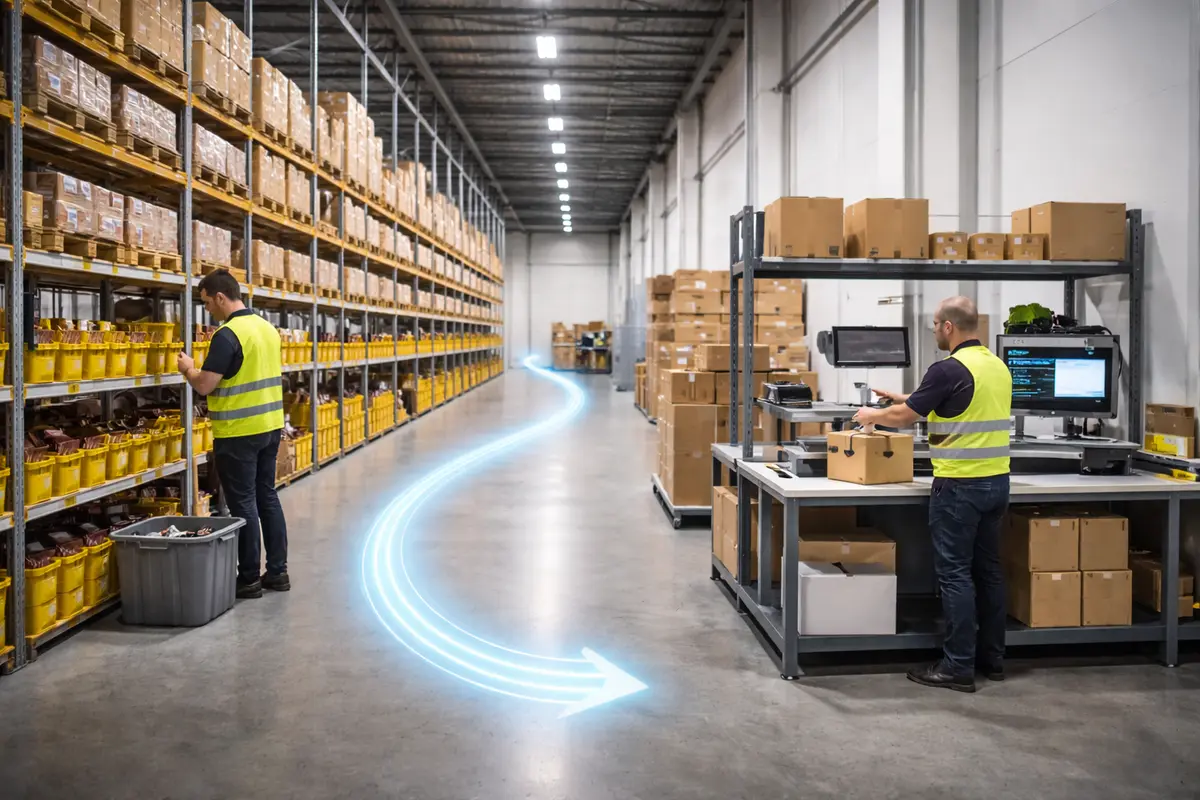
A fulfillment center ships 8,000 orders a day. They invested heavily in pick accuracy: RF scanners, directed pick paths, zone verification. Picking accuracy hit 99.6%. Solid number. But chargebacks kept climbing. Customer complaints about wrong items showed no improvement. Returns for “not what I ordered” stayed stubbornly high.
The problem wasn’t in the pick. It was in the pack.
The pick-to-pack handoff is where orders break down
Most fulfillment operations treat picking and packing as a continuous flow. Items get pulled from shelves, placed in a tote, delivered to a pack station, boxed for shipping. The assumption is that if the pick was right, the pack will be right too. That assumption costs real money.
Between the pick and the pack, several things can go wrong:
Tote contamination. A picker working multiple orders places an item in the wrong tote. The pack station receives a tote that contains an item belonging to a different order. The packer has no reason to question it because the item is in the tote they were assigned.
Sorting errors. Batch-pick and wave-pick systems pull items for many orders at once, then sort them into individual orders at a put-wall or sort station. Every sort decision is a chance for an item to land in the wrong slot.
Staging mix-ups. Completed picks waiting at the pack station can get mixed together, especially during peak volume when staging areas are crowded. An item from Order A gets accidentally pushed into the staging area for Order B.
Multi-item miscounts. An order calls for 3 units of a SKU. The picker pulls 3. During transfer, one falls back into the tote going to the wrong station. Or the packer miscounts and only places 2 in the box, leaving the third on the station for the next order.
Variant confusion. Picture similar products in different sizes or colors. The picker pulls a Medium Blue. At the pack station, the packer grabs from a pile that includes a Medium Green from a different order being packed at the same time. The UPC might be close enough that a quick glance doesn’t catch it.
Each of these scenarios produces a correct pick and an incorrect pack. Your pick accuracy metrics stay green. Your shipped order accuracy doesn’t.
Why most verification stops at pick
The warehouse industry has spent decades optimizing pick accuracy with RF scanning, pick-to-light, voice-directed picking, and goods-to-person automation. These tools have pushed pick accuracy into the 99%+ range at most modern facilities.
Pack verification hasn’t received the same investment, for a few reasons.
The assumption that “pick right = ship right.” If the pick is verified, the thinking goes, why verify again at pack? This ignores everything that happens between the pick face and the pack station.
Scan fatigue. Another scanning step at the pack station slows throughput. Your packers already feel pressure to hit rate targets. Layering scan-verify at pack on top of scan-verify at pick creates a double-scan workflow that nobody wants to follow.
Measurement gaps. Most WMS platforms track order accuracy as a single number. They don’t split pick errors from pack errors. When an order ships wrong, the root cause gets attributed to “the warehouse,” not to a specific step. That makes it hard to build a business case for pack-specific verification.
Cost perception. Pick verification technology is mature and relatively inexpensive. Pack verification, especially visual verification, has historically required more investment. Ops leaders defaulting to “we already verify at pick” is partly a cost-avoidance decision.
Pack is where physical errors happen
Pick accuracy metrics miss something obvious: the pack station is where the physical shipment is actually assembled. Items go from “pulled from inventory” to “in a box addressed to a customer” right here.
Even with perfect picking, the pack station introduces error opportunities that don’t exist earlier in the process:
Assembly errors. Kitting and bundling happen at the pack station. If a kit requires Item A + Item B + Item C, and the packer misses Item C, that’s a pack error, not a pick error.
Packaging selection. Wrong box size, wrong poly mailer, wrong packaging material. All of these decisions happen at the pack station, after the pick is already done.
Insert and collateral errors. Promotional inserts, thank-you cards, branded tissue, samples. None of these get picked from inventory. They live at the pack station and get added during packing. No pick verification system checks for them.
Label errors. Applying the wrong shipping label to a package. Two orders packed side by side, labels printed sequentially. Swap the labels and two customers get each other’s orders. Both picks were correct. Both labels were correct. The match was wrong.
Quality defects. A product arrives at the pack station with visible damage: a dented box, a torn label, a stain. The packer has to make a judgment call. With no verification system watching, some damaged products ship.
Verify at every stage, not just one
You don’t have to choose between pick verification and pack verification. Verify at both, using the method best suited to what each stage can catch.
At the pick
Scan-verify at the pick location confirms the right SKU was pulled from the right bin. This is well-understood technology. Keep doing it. Pick accuracy above 99.5% is achievable with RF scanning and directed workflows.
At the sort/put-wall
If you batch-pick and sort, verify at the sort step. Scan the item, scan the destination slot. This catches tote contamination and sorting errors before they reach the pack station.
At the pack station
This is where visual verification matters most. The pack station is the final controllable point before the order leaves your building. Verification here needs to catch everything that happened between the pick and the seal.
Barcode scan-verify at the pack station catches SKU mismatches. It’s a solid baseline. But it misses visual errors, quantity manipulation, insert compliance, and packaging issues.
AI vision verification fills those gaps. Cameras watch the packing process passively. The system confirms correct items, correct quantities, correct packaging, and correct inserts without the packer changing their workflow. Rabot’s platform integrates with the major WMS platforms running on warehouse floors today and captures a visual record of every order as it’s packed.
The combination of scan-verify at pick and AI vision at pack creates a two-layer verification system. Pick verification catches the easy errors (wrong SKU pulled). Pack verification catches the harder errors (correct items, wrong box; correct pick, missing insert; correct products, wrong label).
The evidence advantage
Pack station verification gives you something pick verification can’t: evidence.
When a customer claims they received the wrong item, you can review the visual record of that specific order’s packing process. You can see exactly what went into the box, how it was packed, and whether the correct label was applied.
Highline Commerce reduced investigation time by 95% using pack station visual evidence. Instead of pulling CCTV footage and scrubbing through hours of video, they access the order-specific record in seconds.
When a client claims an order was packed wrong, you pull up the visual evidence and resolve the dispute in minutes instead of absorbing the cost.
This evidence capability doesn’t exist at the pick stage. Pick verification confirms a scan happened. Pack verification creates a visual record of what actually shipped.
Building a complete pick-and-pack verification workflow
If you’re designing a verification workflow from scratch, here’s a practical sequence:
-
Scan at pick. Confirm the right item is pulled from the right location. Standard RF scanning with WMS-directed workflows.
-
Scan at sort (if applicable). If you batch-pick, verify at the sort/put-wall stage. Scan item, scan slot.
-
Verify at pack. Use AI vision to confirm items, quantities, packaging, and inserts. Capture visual evidence for every order.
-
Verify at ship. Final label scan to confirm the right label is on the right package. Weight check against expected order weight as a sanity check.
-
Measure and separate. Track errors by stage. Distinguish between pick errors, sort errors, pack errors, and label errors. Aggregate “order accuracy” numbers hide the real problems.
-
Close the loop. Feed error data back into root cause analysis. If 60% of your errors are pack-stage label swaps, that’s a station design problem, not a training problem. If 40% are missing inserts, that’s an SOP problem.
The WERC DC Measures benchmark of roughly 99% median accuracy represents the combined pick-and-pack error rate. Facilities that verify at both stages consistently beat it. The question is not whether pack verification is worth the investment. It’s how much you’re losing by not having it.
Stop treating pick and pack as one step. Measure them separately. Verify them separately. The errors hiding in the handoff are probably costing you more than you realize.