What Is Packing Verification? A Complete Guide for Fulfillment Ops
A customer orders a white iPhone 14 case. Your picker pulls the right SKU. Your packer drops it into a poly mailer, scans the shipping label, and sends it on its way. Two days later, the customer opens the package and finds a black iPhone 13 case. Same product family, same shelf location, different SKU. The barcode on the shelf was correct. The pick was correct. But somewhere between the bin and the box, the wrong item ended up in the package.
Packing verification exists to close that gap.
What packing verification actually means
Packing verification confirms that the contents of a package match the order before it ships. Simple concept, but the details matter. Verification can happen at different points, use different technologies, and catch different types of errors.
It comes down to one question: does what’s in this box match what the customer ordered?
That means checking SKUs, quantities, variants (size, color, configuration), and often packaging materials like inserts, branded tissue, thank-you cards, or promo items. If you’re a 3PL running multiple brands from the same facility, it also means making sure Brand A’s product isn’t shipping in Brand B’s packaging.
The WERC DC Measures report puts median order-picking accuracy at roughly 99%. Sounds high. Do the math: a 1% error rate across 5,000 orders per day means 50 wrong packages leaving your building every day. Once you factor in shipping the replacement, processing the return, and the hit to the brand, each error runs into the tens of dollars. At volume, that’s thousands in daily losses from errors that verification could have caught.
Three approaches to packing verification
Not all verification works the same way. Each approach trades off speed, accuracy, and cost differently.
Barcode scan-verify
The most common method. The packer scans each item’s barcode at the station, and the WMS compares the scanned UPC against the order manifest. Match? Green light. Mismatch? Flag.
Scan-verify is fast and cheap to implement. Most WMS platforms support it natively or through add-ons. It catches SKU-level errors reliably: wrong product, missing item, extra item.
CCTV review
Some operations mount cameras over pack stations and record the packing process. When a dispute or complaint comes in, someone pulls the footage, scrubs through it, and tries to determine what happened. This is verification after the fact rather than at the point of packing.
CCTV gives you an evidence trail but doesn’t prevent errors. It’s reactive. Reviewing footage manually is slow, too. Most facilities that rely on CCTV for order verification spend 45-60 minutes per investigation.
AI vision verification
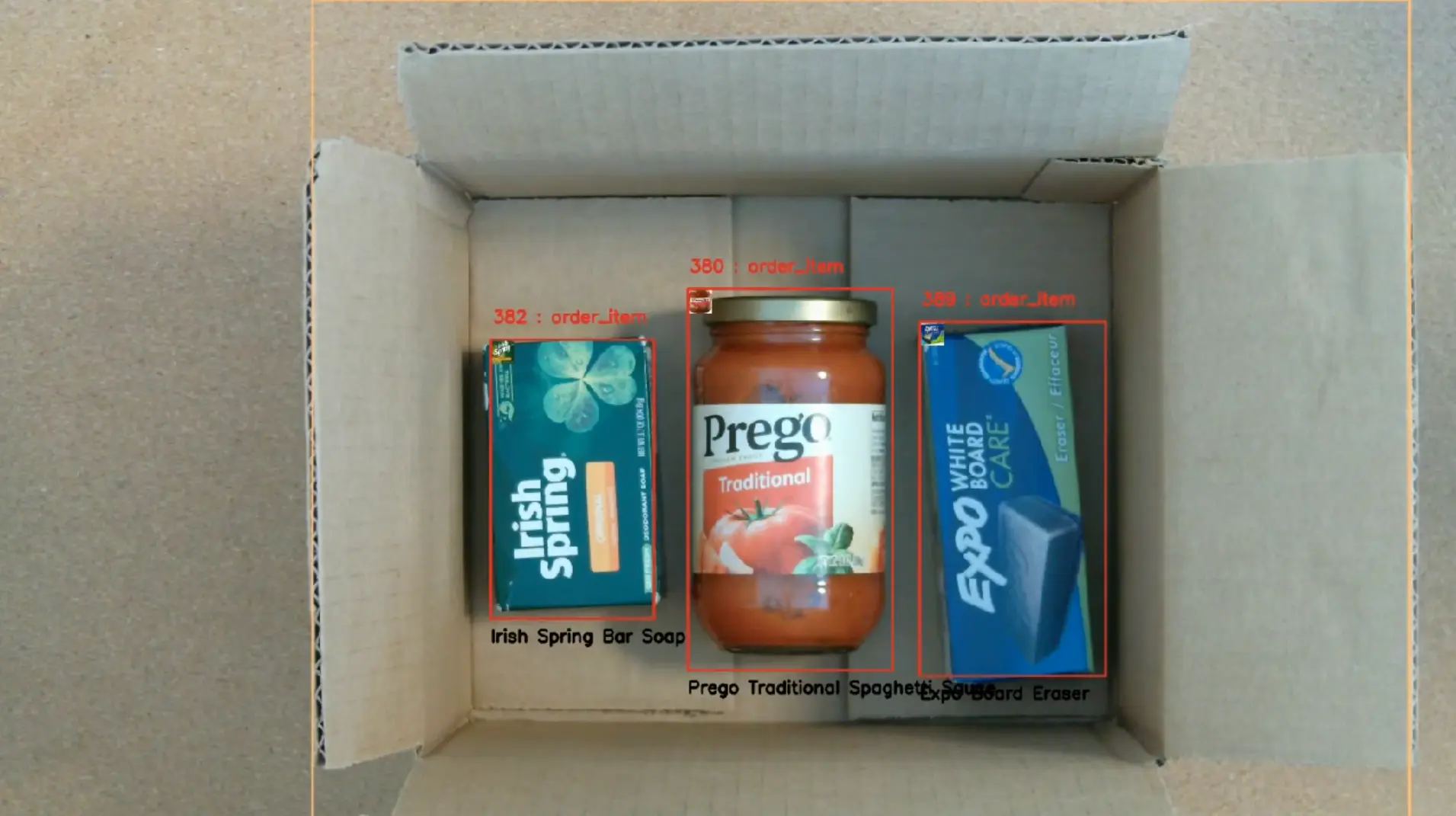
The newest approach. Cameras at the pack station capture order contents in real time. Computer vision models identify items, count quantities, check variants, and verify packaging compliance, then confirm or flag the order before the box is sealed.
There’s no scanning step, no pause in the workflow. Verification happens passively as items move through the station.
What scan-verify misses
Scan-verify is a solid foundation, but it has blind spots that matter in high-volume operations.
Visual errors. A barcode can’t tell you that the blue shirt is actually green under warehouse lighting. It can’t detect that a product’s retail packaging is damaged, that a label is applied upside-down, or that a fragile item was tossed into a box without bubble wrap.
Quantity manipulation. If a packer scans one item twice (or the system double-registers a scan), scan-verify shows two items scanned. But there might only be one in the box. The barcode says it’s right. The box says otherwise.
Packaging compliance. Branded inserts, tissue paper, specific box sizes, void fill requirements. None of these have barcodes. Scan-verify can’t confirm that your client’s unboxing experience matches their brand guidelines.
Process compliance. Was the item placed in the box correctly? Was the dunnage adequate? Was the label placed in the right location? These are physical, visual checks that a barcode scanner simply cannot perform.
Multi-item confusion. In orders with multiple units of the same SKU but different attributes (size small and size medium of the same shirt), scan-verify may not distinguish between them if the UPCs are similar or if the packer scans the wrong item multiple times.
If your margin of error is tight or packaging presentation matters to the brand, scan-verify alone leaves real risk on the table.
How AI packing verification works at the station
AI-based packing verification uses cameras mounted at or above the pack station to watch the packing process. Here’s the typical flow.
Order assignment. An order hits the station, either pushed from the WMS or pulled by the packer. The system knows what should be in the box.
Passive capture. As the packer places items, overhead cameras capture images or video. No scanning, no button-pressing, no holding items up to a camera. The packer doesn’t change their workflow.
Real-time analysis. Computer vision models process the visual data as it happens. They identify products by appearance, check quantities, verify packaging materials, and assess SOP compliance.
Confirmation or alert. Everything checks out? The system confirms and the packer moves on. Something wrong? The packer gets an alert before the box is sealed and can fix the error on the spot.
Evidence capture. Every order gets a visual record, timestamped and linked to the order number. When a customer disputes an order three weeks later, you pull up the footage and resolve it in minutes instead of hours.
You get the prevention of scan-verify and the evidence trail of CCTV, without the workflow disruption of one or the reactivity of the other.
Rabot’s system integrates with the WMS platforms already running on your floor and embeds directly into the packer’s existing workflow. No changes to station layout or process.
What to look for in packing verification software
If you’re evaluating packing verification solutions, here’s what separates tools that work in a demo from tools that work at 3 AM during peak season.
WMS integration depth. Does the system plug into your WMS, or does it require a parallel workflow? The best solutions pull order data directly from your WMS and push verification status back without the packer touching a second screen. Look for pre-built integrations with your specific WMS, not just API availability.
Accuracy at production speed. Verification that slows down the packer is verification that gets turned off. Ask vendors about processing latency. Can the system keep up with your fastest packers? Get references from facilities running at your volume.
Edge vs. cloud processing. Edge processing (on-site hardware) means the system works even when your internet drops. Cloud processing may offer more powerful models but adds latency and connectivity dependency. Some systems use a hybrid approach.
Error taxonomy. What types of errors can the system catch? SKU errors are table stakes. Can it verify quantities? Variants? Packaging materials? Label placement?
Evidence and audit trail. Can you pull up the visual record for any order, any time? How long is data retained? Can you share evidence directly with clients for dispute resolution?
Multi-client support. If you’re a 3PL running multiple brands, can the system enforce different SOPs and packaging standards for each client from the same station?
Scalability. How does licensing work? Per station? Per order? Per camera? Understand the cost model at your current volume and at 2x. Some solutions get expensive fast.
Operator experience. The packer is the end user. If the system creates friction or generates too many false alerts, adoption drops. Ask about false positive rates and what the packer’s experience looks like over an 8-hour shift.
Packing verification has gone from a manual checkpoint to an automated, visual, real-time process. The right approach depends on your error profile, your volume, and how much risk you’re willing to ship out the door every day. Start by understanding where your current errors come from. Then match the verification method to the gap.