Returns Is a Workflow Problem. We Built Rabot Undo to Solve It.
A dozen-plus customers have been asking us to solve returns. Small 3PLs, big retailers, the same ask. Today we did. It is called Rabot Undo.
I have spent twenty years on warehouse floors, and returns is the workflow I have watched the most teams try and fail to fix.
I have also done the work myself. Before Rabot, I picked up warehouse shifts through Wonolo so I could see more operations from the inside. One week I was processing returns for Allbirds shoes. A pallet comes in. You go one box at a time. Open it. Check the shoes. Look for scuffs. Decide whether they were lightly worn, damaged, sellable, or needed to be graded differently.
It was simple on paper. It was not simple on the floor.
Here is what twenty years taught me about why. It isn’t the AI. It isn’t the cameras. It isn’t the UI. It is the workflow itself.
Returns is a recipe
Returns is a recipe: a set of steps for what to do when a box comes back. Intake it, identify the order, photograph the condition, inspect what is inside, verify it, decide the disposition, and route it to restock, repair, or dispose.
Most warehouses already have a version of that recipe somewhere. In the WMS. In an SOP binder nobody opens. In the head of the supervisor who has been there longest and trains every new hire by walking the floor with them.
The recipe does not matter if nobody follows it. It matters less when the version on paper is not the version being run on the floor. And it matters least of all when an operator quietly figures out a better way to do step three, and that change never finds its way back into the system.
That gap, between the recipe and what is actually happening, is where returns breaks.
You cannot fix it by locking it down
Most software’s instinct, when operators drift, is to lock it down harder. That is the wrong instinct. You do not solve a process problem by punishing the only people who can see the process.
The right answer is two layers.
Portal is where the recipe lives. You define it, version it, and change-control it. Every step is traceable. The instructions live in one place, and they live correctly.
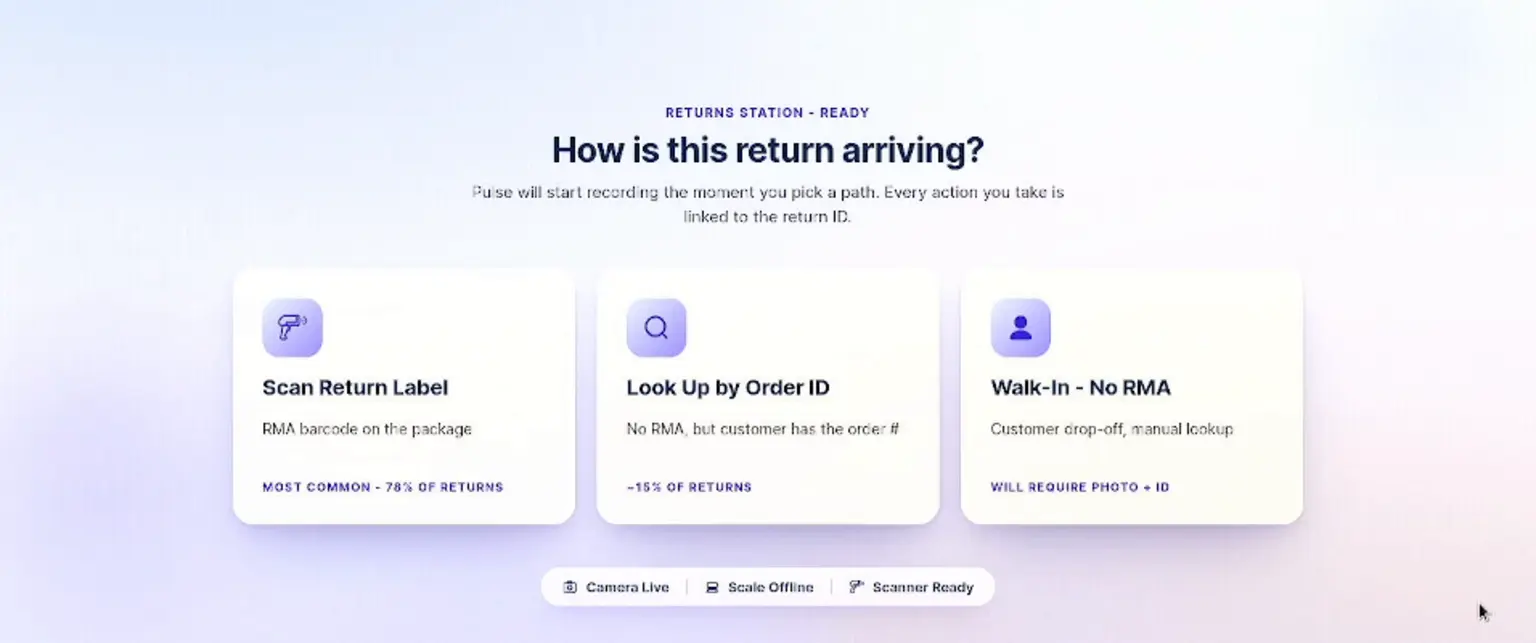
Pulse is the operator UI. No two returns are the same. Damaged box. Wrong SKU. Missing receipt. The customer wanted a re-ship, not a refund. Pulse adapts to the return in front of the operator, instead of asking the operator to adapt to it.
The two feed each other. An operator finds a better way, and the recipe updates. The recipe updates, and Pulse reflects it. When reality and instruction drift apart, you can see it, and you decide which one is wrong.
That last part is the piece everyone else skips. Rabot watches the actual sequence of steps on the floor and flags when it diverges from the authored one. Today, the operator is doing all of that reconciliation in their head, every shift, with no way to push what they have learned back upstream. That is why returns is broken. No amount of AI or UI fixes it until somebody sits down and thinks through the operator and the process together.
What Rabot Undo does
That is what we did. We built returns as its own workflow under Instructions, and we called it Rabot Undo.
- Video-documented inspection. Every return is captured on camera, and its condition is verified before it hits inventory.
- Condition verification. AI-assisted inspection flags damage, missing items, and discrepancies automatically.
- Automated triage. Route each return to restock, repair, or dispose based on its verified condition.
- Full audit trail. Timestamped video evidence for every return, so a dispute is resolved in seconds, not days.
It runs on the same platform that powers Pack: Rabot Edge at the station, Pulse for the operator, Portal for the manager. If you already run Rabot on your pack line, returns is the same system pointed at a different problem.
Why this matters
Returns is not a side issue for e-commerce. It is the part that is making the rest of it unsustainable. Getting it right is not about adding another camera or another dashboard. It is about treating the workflow as the product, the operator as the expert, and the gap between them as something you can finally see and close.
Rabot Undo is available now in beta.
See Rabot Undo in action. Book a demo and we will bring video-verified returns to your returns line.