The Hawthorne Effect in the Warehouse: Why Spot Audits Don't Show You Reality

Ever notice how the problem you are chasing disappears the second you go looking for it?
A pack station runs slow all week. A supervisor walks over with a stopwatch, and suddenly the operator is quick, everything is by the book, and the numbers look great. You write down the good number, and the slow days keep coming back.
There is a name for this, and it comes from a factory.
What the Hawthorne effect actually is
Between 1924 and 1933, researchers working with Harvard Business School ran a series of experiments at Western Electric’s Hawthorne Works, a large factory complex in Cicero, Illinois, just outside Chicago. The first studies changed the lighting at the plant to see how it affected output. Productivity went up. Then they dimmed the lights back down, and productivity went up again. Across the experiments, almost every change the researchers made, in either direction, seemed to improve performance.
The conclusion that stuck: the workers were not responding to the lighting. They were responding to being watched. The sociologist Henry Landsberger later gave the phenomenon its name, the Hawthorne effect, in a 1958 re-analysis. The people who ran the original studies never used the term themselves.
Here is the honest part, because it changes how much weight to put on this. When economists Steven Levitt and John List recovered and re-analyzed the original illumination data in 2011, they found the dramatic textbook version was overstated. The most famous data patterns turned out to be largely fictional, though subtler effects consistent with observation changing behavior did remain, and they proposed a sharper statistical test for detecting them. A separate 2014 systematic review in the Journal of Clinical Epidemiology reached a careful verdict: participation and observation effects are real and recur across studies, but they are hard to isolate and quantify cleanly.
So the precise size of the effect is genuinely debated. The core mechanism is not, at least not by anyone who has stood on a floor with a clipboard: people behave differently when they know someone is watching. Not because they are cutting corners the rest of the time, but because attention changes behavior. It is human.
Why this quietly breaks warehouse measurement
Most of how we measure operations is built entirely out of observation events.
- Time studies put a person with a stopwatch behind an operator for ten minutes.
- Gemba walks send a leader to the floor to see problems firsthand.
- Quality audits sample a slice of orders while everyone knows the audit is happening.
Every one of these is a moment where the operator knows they are being watched. So every one of them is subject to the same distortion. You are not measuring a normal shift. You are measuring the version of the shift that shows up when the clipboard comes out.
Two problems compound here. The first is coverage: watching ten minutes of an eight-hour shift is roughly 1% sampling, so you are already extrapolating from almost nothing. The second is the Hawthorne effect: that 1% you do capture is the least representative 1% of the day, because your presence changed it.
You end up with a confident number that describes a moment that does not actually repeat.
The real cost: you optimize the wrong thing
When your best data is the observed data, you tune your whole operation around the observed behavior. You redesign a station based on the time you recorded while standing there. You sign off on a process because the audited orders looked clean. Then throughput sags the following week and nobody can say why, because the thing that actually costs you only happens when no one is measuring.
This is the trap. The harder you look in short bursts, the more you train the floor to look good in short bursts. You can run this loop for years and never see the normal shift.
The fix is not looking harder. It is never stopping.
The Hawthorne effect depends on a difference between observed and unobserved. Remove that difference and the distortion goes with it.
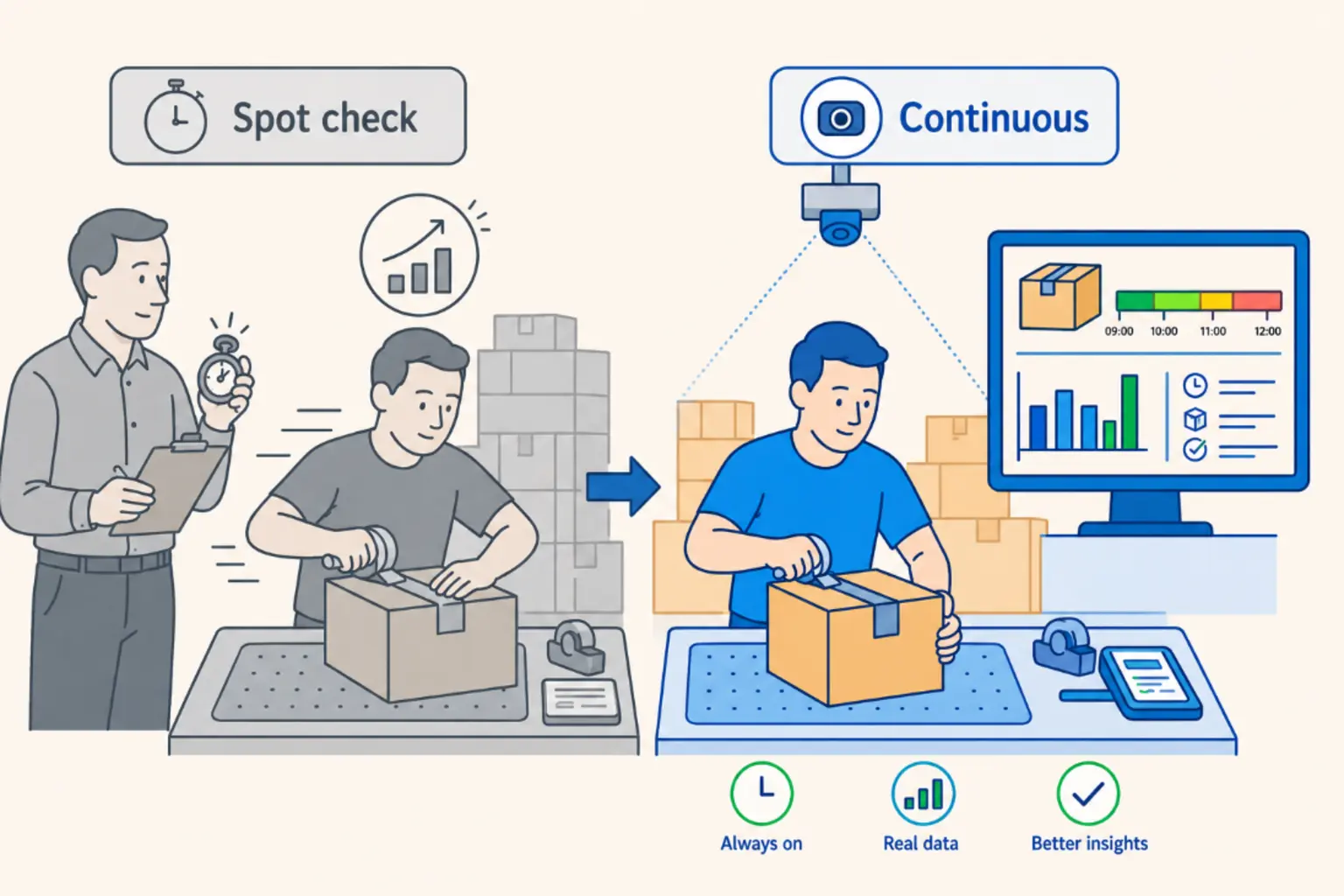
When measurement is continuous and ambient, there is no special “we are being watched” state, because every shift is recorded the same way. Vision AI mounted at every pack station turns every motion into a time-stamped record, running quietly in the background with no one hovering. Operators stop performing for the camera within a day or two, the same way you forget the dashcam in your car. What you are left with is the ordinary shift, captured in full, which is the only thing worth improving.
This is the difference between a spot check and a digital gemba: one is a moment you stage, the other is a record that is always on.
What continuous measurement surfaces
Once you are measuring the real shift instead of the performed one, the improvements are not exotic. They come from finally seeing what was always there, and from tracking the KPIs that actually run a floor against continuous data instead of sampled snapshots.
- Staci digitized its audits and lifted productivity 33% while cutting QA cost 60%.
- Atomix went from 35 orders per hour to 79 and dropped pack cost 64%, scaling from 3 stations to 20. You can read the full Atomix story here.
- Davinci cut its exception rate from 7.5% to 2% by acting on continuous vision data instead of periodic samples.
None of these came from a clever new incentive or a harder audit. They came from data the teams had never had before, about the shift as it actually runs.
The bottom line
Your WMS records what was supposed to happen. Your audits record what happened while you were watching. Neither one records the normal shift, and the normal shift is where all your cost and all your opportunity live.
The Hawthorne effect is not a quirk of one 1920s factory. It is the reason a century of operations measurement has been quietly measuring the exception. The way out is not a better stopwatch. It is to stop looking in bursts and start seeing all of it.
References and further reading
- Harvard Business School Baker Library, The Human Relations Movement: Harvard Business School and the Hawthorne Experiments. The archival home of the original Western Electric research.
- Roethlisberger, F. J., and Dickson, W. J. (1939). Management and the Worker. Harvard University Press. The primary account of the studies.
- Encyclopaedia Britannica, Elton Mayo and the Hawthorne Studies.
- Levitt, S. D., and List, J. A. (2011). Was There Really a Hawthorne Effect at the Hawthorne Plant? An Analysis of the Original Illumination Experiments. American Economic Journal: Applied Economics, 3(1), 224–238. Working paper via NBER.
- McCambridge, J., Witton, J., and Elbourne, D. R. (2014). Systematic Review of the Hawthorne Effect: New Concepts Are Needed to Study Research Participation Effects. Journal of Clinical Epidemiology, 67(3), 267–277.
Ready to see your real shift? Book a demo to see Rabot in action.