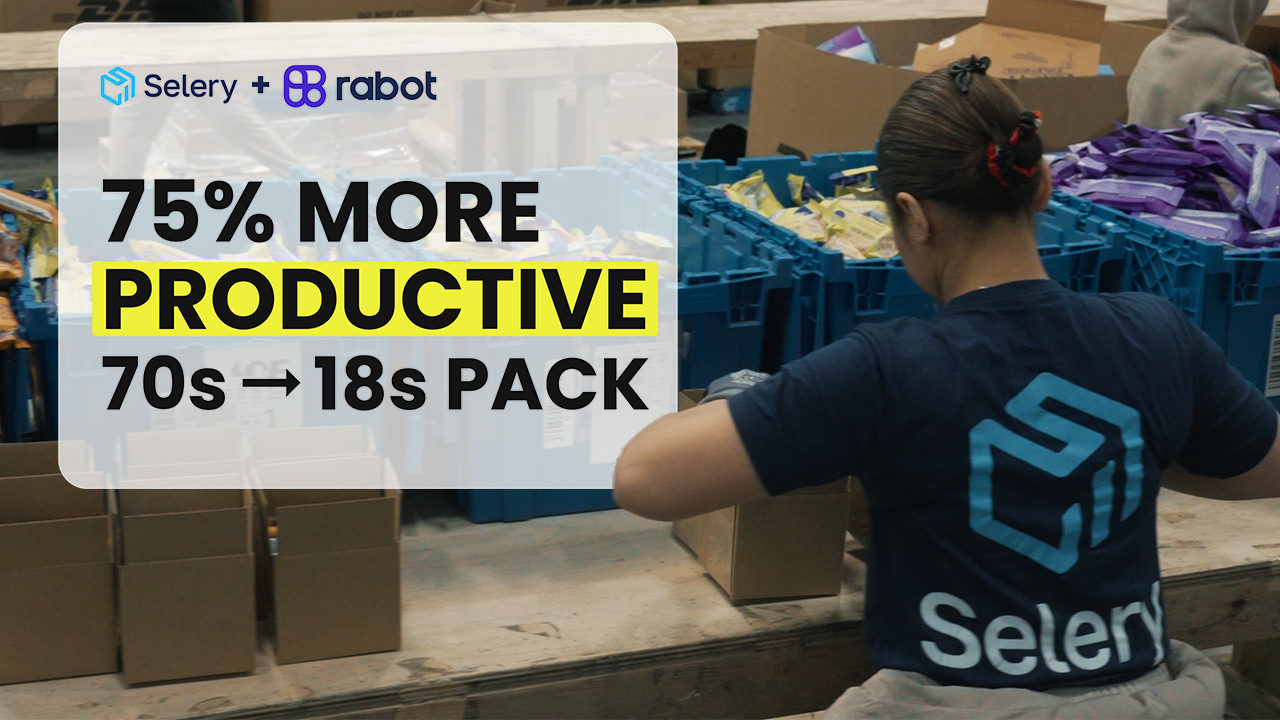
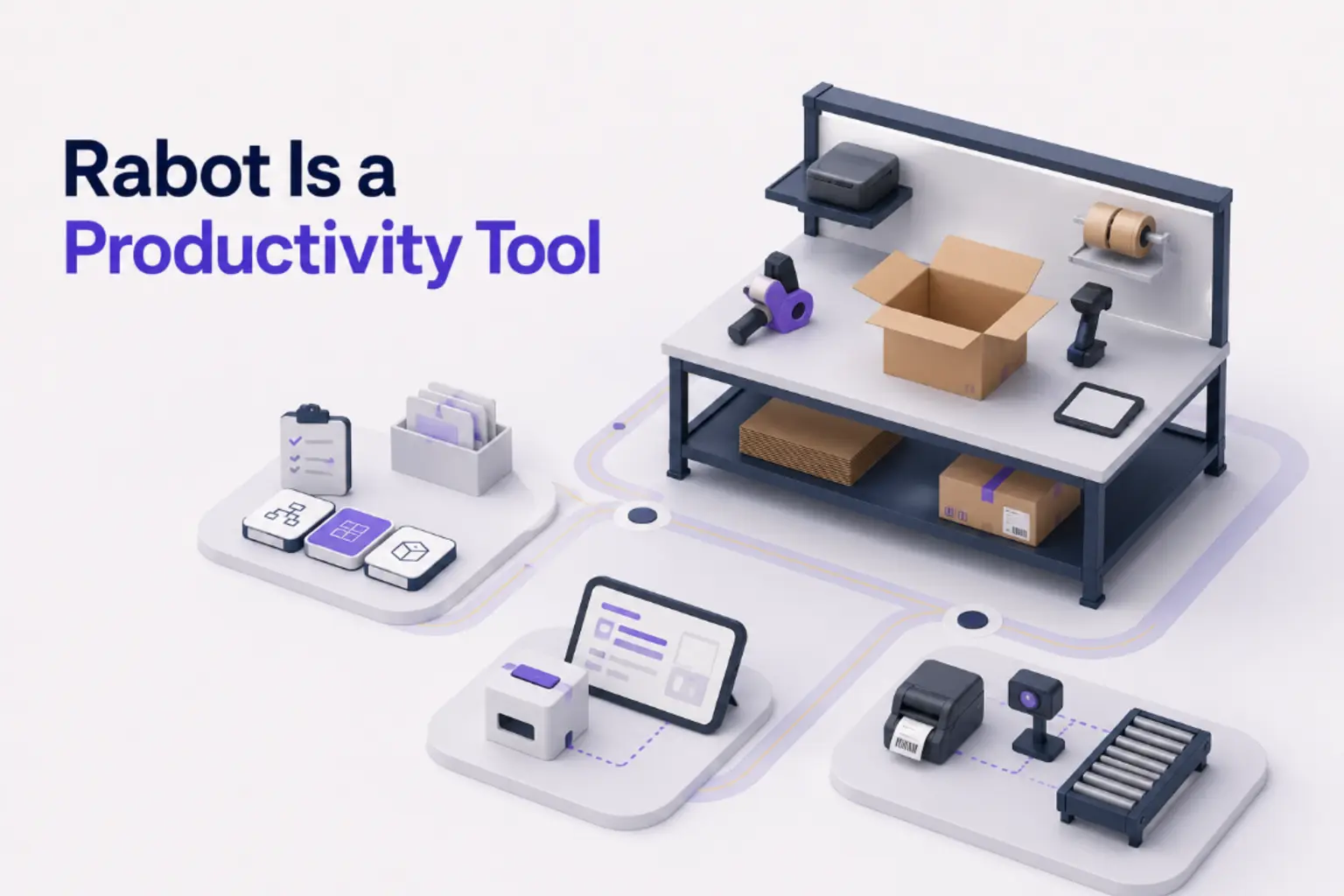
Case Study: How Atomix Cut Pack Costs 64% and Scaled From 3 Stations to 20
Case Study
Atomix Logistics
Doubled pack rates and cut cost per package 64% by turning pack-station cameras into a production tool.
Key Results Achieved with Rabot
- Pack rate doubled: from 35 to 79 orders per hour for their top customer
- Cost per package dropped 64%
- Scaled from 3 to 20 Rabot stations in under 12 months
- Estimated 5 to 10 FTE equivalent savings through real-time productivity management
About Atomix Logistics
Atomix Logistics is a bootstrapped third-party logistics (3PL) company founded in 2020. It has become one of the fastest-growing logistics companies in the U.S., earning a place on the 2025 Inc. 5000, with fulfillment centers in Milwaukee, Salt Lake City, and Baltimore. Atomix serves direct-to-consumer brands in health and wellness, food and beverage, skin care and cosmetics, and luxury goods, pairing technology-driven operations with a hands-on, high-touch approach to fulfillment.
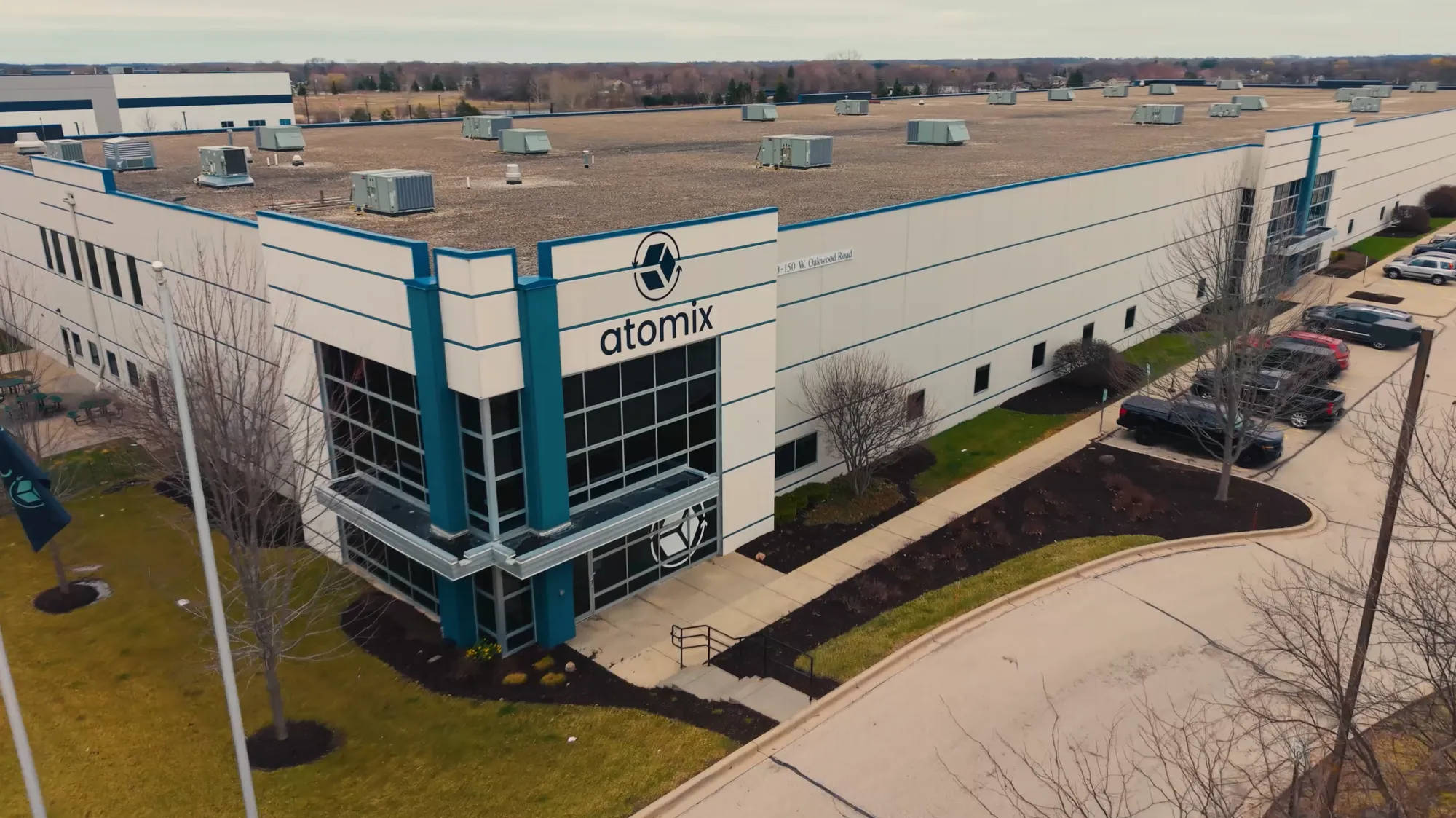
“In the last five years we’ve scaled from just 500 square feet to over 200,000 in order to maintain SLA quality and accuracy. That can only be possible with partners like Rabot.”
— Austin Kreinz, CEO, Atomix Logistics
The Challenge: No Visibility Into What Actually Happens at Pack Stations
Before Rabot became central to their operations, Atomix had a visibility problem. They could see macro-level order volumes in their WMS, but had no way to understand what was actually happening at each pack station: how long orders took, why some packers were faster than others, or where time was being wasted.
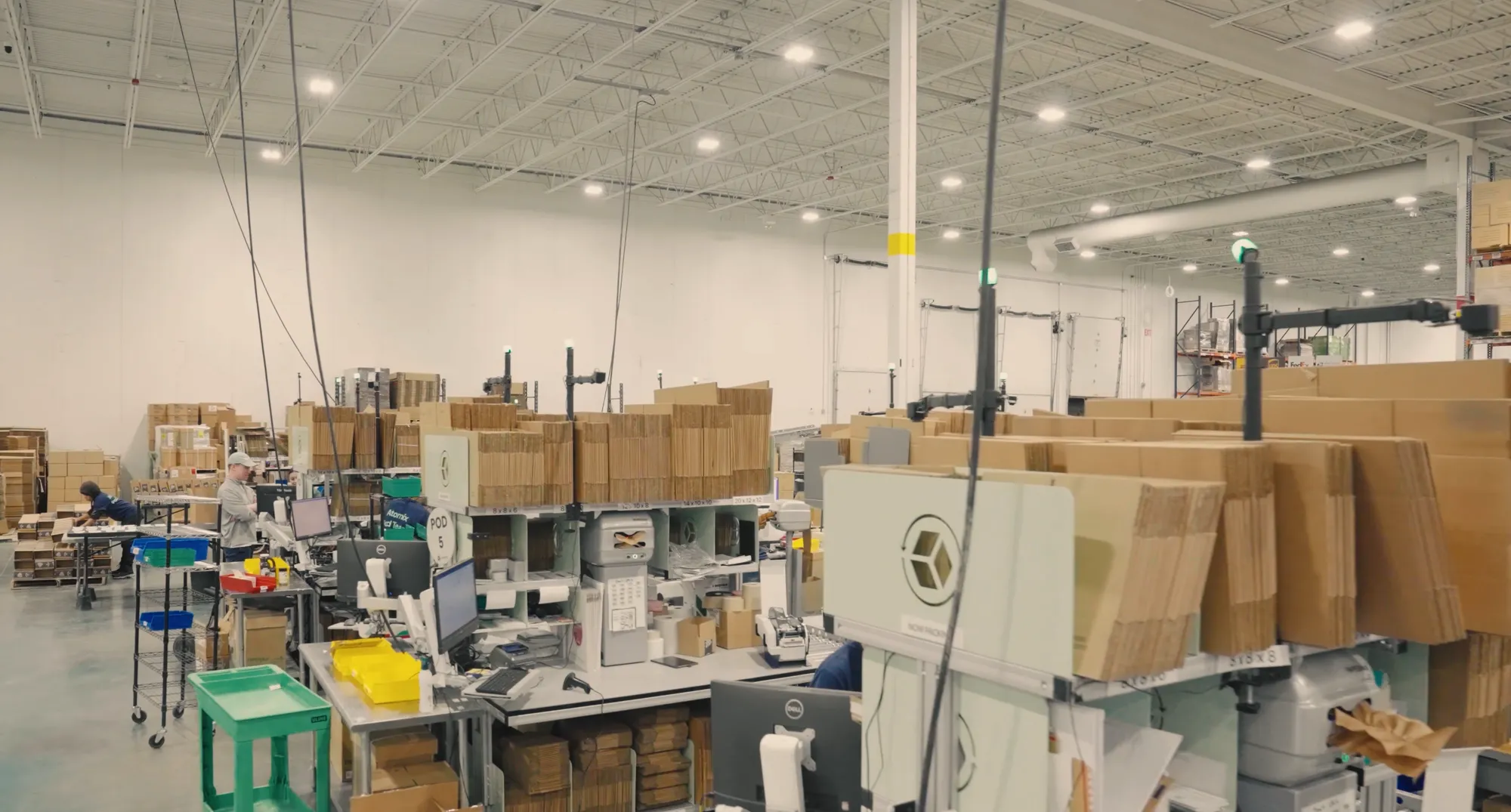
The warehouse ran a kitting-style assembly line: five people at one station, each doing a discrete step. It worked, but it didn’t scale.
Drake Meyer, who joined Atomix as VP of Operations in early 2025, saw the limitations immediately:
“It’s going to be impossible for us to grow to where we want to be if we have to kit every new big customer. One person has to go to the bathroom. The whole line shuts down.”
— Drake Meyer, VP of Operations, Atomix Logistics
Drake had already used Rabot at his previous company, DaVinci Micro Fulfillment, where Rabot helped cut processing time by 30%. He knew what the platform could do when fully deployed. When he arrived at Atomix, he found three Rabot cameras on the pack floor, used for quality and video lookup. Valuable, but not yet tapped for throughput: he had no warehouse-wide visibility into pack performance by customer, day, hour, or employee.
The Transformation: From Assembly Line to Single-Operator Stations
Drake moved fast, and let the data make the case. Atomix put one person on a station with a Rabot camera, let them pack, and took the numbers; the single-operator setup proved faster and more efficient. On that evidence, he dismantled the kitting assembly lines and rebuilt the floor around single-operator pack stations: one person per station, each fully responsible for their orders from scan to ship.
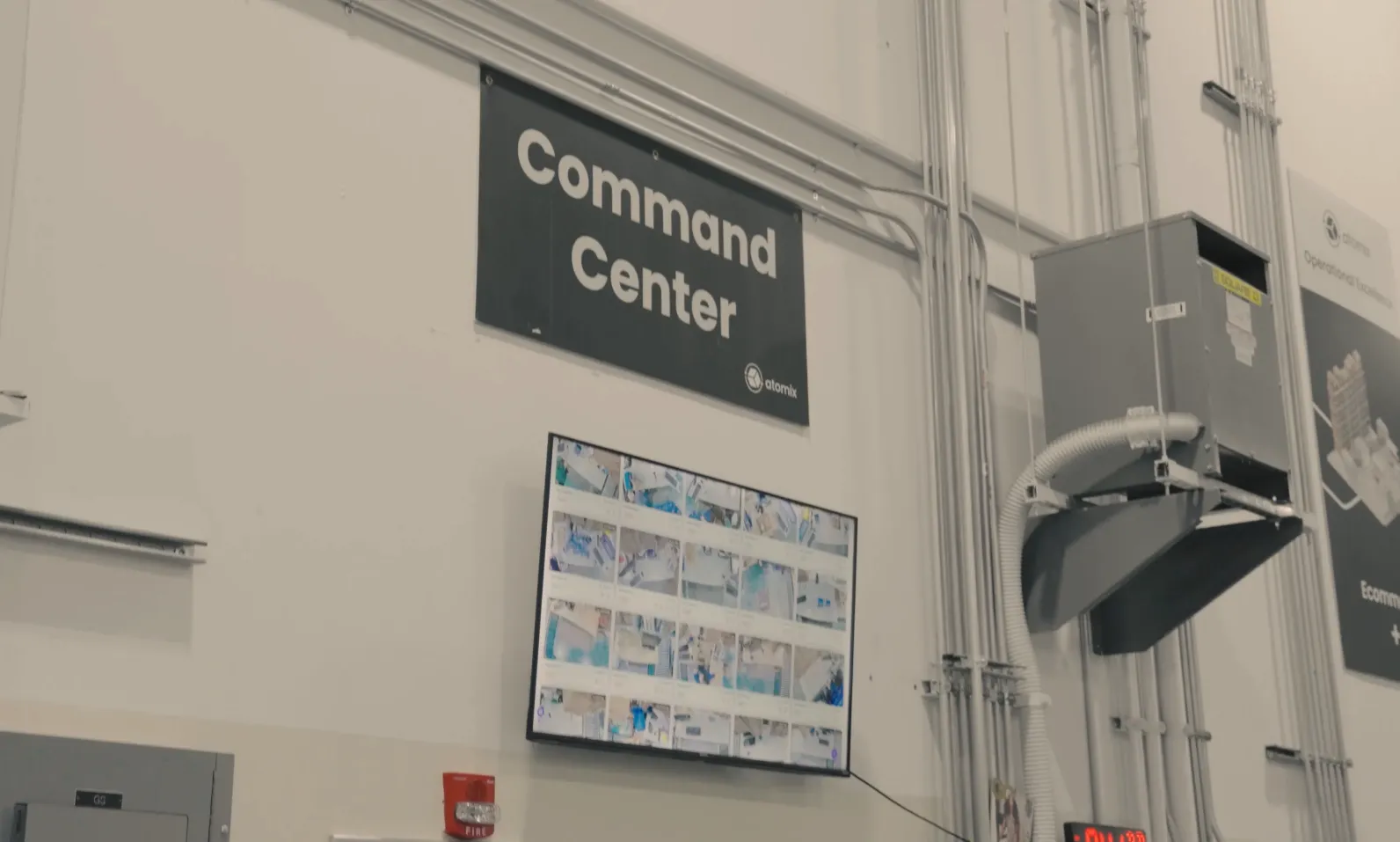
He installed Pallite modular pick faces, built a command center with dashboards and whiteboards, and, critically, put the existing Rabot cameras to a new use. The goal wasn’t just quality video anymore. It was real-time production management.
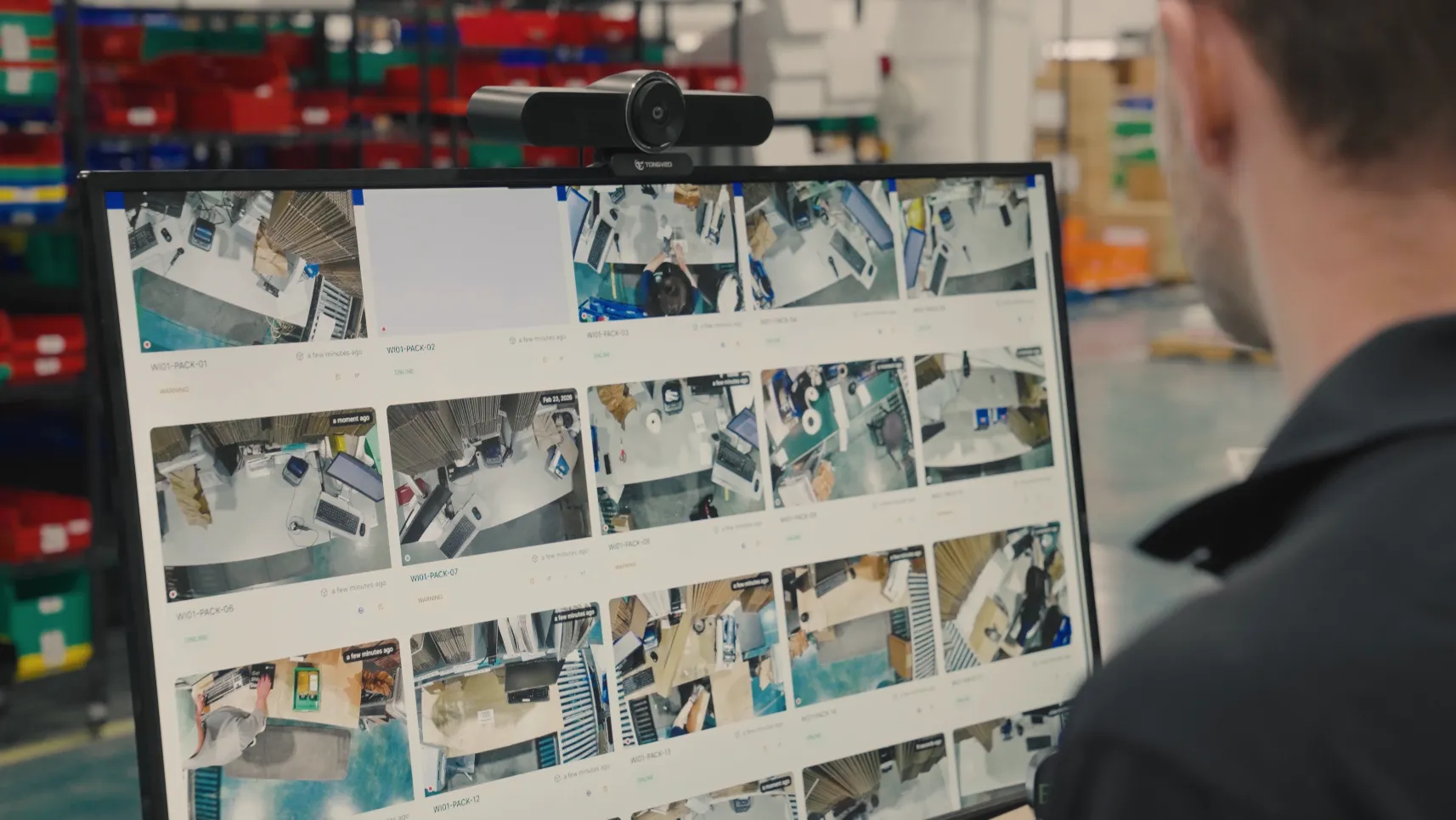
“What I picture right here is a Rabot camera telling me fastest pod, fastest employee, fastest customer. I can click in and see what’s happening and why we’re not pumping more boxes out of a pod.”
— Drake Meyer, VP of Operations, Atomix Logistics
Early Results: The Data Changes Everything
Within weeks, the data started telling stories that Atomix couldn’t access before.
Catching Hidden Rework
On one of the first days with full visibility, Andrew Webber (Atomix CTO) discovered that a 13-unit order had been attempted seven times, each attempt requiring a complete rescan of every item. The reprocessing time was, in his words, “insane.”
It exposed a blind spot every operator lives with. No matter how advanced the WMS, it only knows what people enter into it, and the system had this order marked as worked, with no idea it had been torn down and rescanned seven times. That gap between what the software records and what actually happens at the station is a black box. Rabot’s camera is what fills it.
Atomix implemented a two-attempt maximum rule: after two failed attempts, a manager must intervene. The impact was immediate.
“Boom. You’re already seeing attempts are down to two. That’s basically our max. That is massive.”
— Andrew Webber, CTO, Atomix Logistics
From Quality Tool to Production Tool
The bigger shift was philosophical. Rabot stopped being a quality check and became how the pack floor was run. By mid-2025, the Rabot dashboard was a permanent fixture of the command center, visible all day, every day.
By September 2025, the results were measurable: Atomix had pushed pack rates more than 20 orders an hour higher. Three weeks later, the numbers got even better:
“1 month ago we averaged around 35 orders an hour for our top customer. Today we are at 79 orders an hour. Rabot is a production tool not just a quality check. Let’s keep going.”
— Drake Meyer, VP of Operations, Atomix Logistics
Scaling: 3 Stations to 20
The expansion happened organically, driven by results rather than mandates. Atomix’s first three Rabot stations were focused on quality and video lookup. Putting Rabot on more stations unlocked what a handful never could: the coverage to measure and optimize across the whole floor in real time, not just sample a few stations. That breadth is what made the productivity and cost gains measurable and repeatable. Coverage grew through 2025: ten pack stations by mid-year, expanding further as Atomix moved into a new 150,000 sq ft warehouse that October, every station outfitted with a camera and an andon light.
Patrick Day, Atomix COO, had been pushing for full coverage:
“Patrick really wants Rabot on every pack station. He’s asked me, like, how do you get this done?”
— Drake Meyer, VP of Operations, Atomix Logistics
By December 2025, all 20 stations were live. The andon lights glowed green, orange, or red from across the floor. Slack alerts fired when packers called for help. The CX team could look up any order and watch the pack video in seconds.
How Rabot Changed Day-to-Day Operations
Real-Time Floor Management
Before Rabot, identifying a slow station meant manually pulling data: hours of work for historical insights that packers couldn’t remember or act on. With Rabot, Atomix’s floor leads can see every station’s status in real time.
“I don’t want to be reactive tomorrow. If a station is slow, I need to be reactive within 10 minutes.”
— Drake Meyer, VP of Operations, Atomix Logistics
Brand-Level Intelligence
Atomix fulfills for many e-commerce brands, each with different packaging requirements and pack times. Rabot automatically segments performance by brand, something that would be impossible to track manually at scale.
“I could pack all day, 20 different brands, and Rabot can decipher which brands I did and how long it took for each one and give me a rate. That’s the big win for us. For us to set for each brand what the pack rate should be and monitor it is not feasible.”
— Drake Meyer, VP of Operations, Atomix Logistics
Atomix’s billing and sales teams now use this data to analyze margins by client and price fulfillment services more accurately.
“It gives you a benchmark per employee, lets you know what your goals are, your KPIs, and be able to grade and judge each client and employee to be able to hit that goal.”
— Patrick Day, COO, Atomix Logistics
Video Evidence for Customer Claims
When a customer reports a missing item, the CX team pulls up the order in Rabot, watches the pack video, and resolves the claim, with no cycle counts and no tracking down the packer.
“I’m watching people pack, I’m watching them put the products into every single box. I’m seeing how they’re taping, I’m seeing how they’re putting the packing paper into a package. It’s like I’m being the packer.”
— Kayla Ford, CX Manager, Atomix Logistics
A Sales Differentiator
Preston Dull, Atomix’s Head of Growth, started using Rabot independently on sales calls:
“We commonly use it on our sales calls. It’s a big plus that we can recall the video of the package being packed up.”
— Preston Dull, Head of Growth, Atomix Logistics
The Labor Math
Drake estimates real-time actionable data saves the equivalent of 5 to 10 full-time employees:
“Over a year, the amount of time that we’re going to save by being able to action it right away is… I would say five to ten [people]. Easy.”
— Drake Meyer, VP of Operations, Atomix Logistics
The math tracks. Before Rabot, supervisors spent hours compiling performance data. Packers left stations unnoticed. Slow stations went unaddressed until end-of-day reviews. With Rabot, every one of those gaps becomes visible and actionable in minutes, not days. If ten people are supposed to be packing but only five stations are green, someone’s missing, and a floor lead knows it immediately.
What’s Next
Rabot is already expanding into Atomix’s Salt Lake City facility, and the team is exploring new use cases: SOP enforcement that goes beyond binders and sign-off sheets, and aerial cameras for warehouse-wide flow monitoring.
“Nobody has solved the problem of SOP enforcement. We can build it, put it in a binder, have people sign off on a piece of paper, but that’s as far as anyone’s ever got. The last step now is: make everybody watch the video.”
— Drake Meyer, VP of Operations, Atomix Logistics
A Repeat Champion
Drake Meyer’s journey with Rabot is unusual. He first deployed the platform at DaVinci Micro Fulfillment, where it cut processing time by 30% and dropped exception rates from 7.5% to 2%. When he moved to Atomix, he brought the playbook with him and expanded it.
At DaVinci, Rabot drove efficiency by automating parts of the packout workflow. At Atomix, Drake turned it into an active production-control system, the operating system for the entire pack floor, proving that the platform scales with the ambition of the operator.
“If somebody comes in and tries to sell me something that’s going to help with quality, that’s good and it gives me a warm feeling. But when you show me this [the analytics dashboard], that’s money for me. That’s where it’s at.”
— Drake Meyer, VP of Operations, Atomix Logistics
That conviction runs to the top of the company:
“Being at the cutting edge of technology helps us deliver our core mission of high touch fulfillment for high growth brands and leveraging a tool like Rabot. I’d recommend to every operator out there.”
— Austin Kreinz, CEO, Atomix Logistics
Want similar results? Book a demo
About Atomix Logistics
Atomix Logistics is a bootstrapped 3PL founded in 2020 and named to the 2025 Inc. 5000, with fulfillment centers in Milwaukee, Salt Lake City, and Baltimore. Atomix pairs technology-driven operations with a high-touch approach to fulfillment for direct-to-consumer brands across health and wellness, food and beverage, skin care and cosmetics, and luxury goods.
About Rabot
Rabot provides Vision AI for fulfillment operations, delivering real-time visibility into packing performance through pack-station cameras, automated order verification, dynamic SOPs, and production analytics. Rabot processes over 131 million items and 142 billion video frames across its customer base.
Want the full picture?
See the metrics, video, and detailed breakdown.